
DAte
Jun 20, 2025
Content
Reading Time
5 min

This beautiful job at argan.ai for example. Yes, the ‘feels section’ of this month's newsletter is over and we are getting down to brass tacks. Because focus is paying off. Cliffhanger, scroll down to the performance section if you are running short on time.
Barring energy prices, the markets and NINA were actually pretty sanguine during rocky June. Snapshots of the swap markets during June would suggest that they were firmly pricing in a resolution as the most likely outcome. This while viewing the escalatory tail scenarios as incredibly unlikely. It was only after the direct operation by the US that, for example, the overall implied volatility for August WTI crude‐oil options spiked towards double the realized vol range. Moreover betting markets' odds of escalations spiked. But immediately the Monday after that, the United States called for a definitive cease-fire that held its ground. Markets normalized again.
Staying with our process and our system, tracking and analyzing fundamentals, and being fully tuned in with market expectations, just like in April, paid off.
June:
What else happened in June?
Our system showed that the inflation data (CPI) started signalling price pressures in the sectors that are most exposed to Chinese trading. But, the other characteristics of the data showed positive signs in terms of trend in the overall inflation rates.
Our assessment is that the net effect of tariffs on growth combined with the weakening trend in US housing, which is approximately 40% of the CPI, will result in a continued downward trend. Having said that, as the inventory front running of goods purchases depletes, we will see more pressure on goods prices in H2 2025. We are not in the inflation forecasting business though, I use the characteristics of inflation data as inputs for NINA’s assessment of markets. As shown below from the latest release, we do see core goods inflation picking up again for a good while now, which could be further exacerbated by the effects of tariffs.
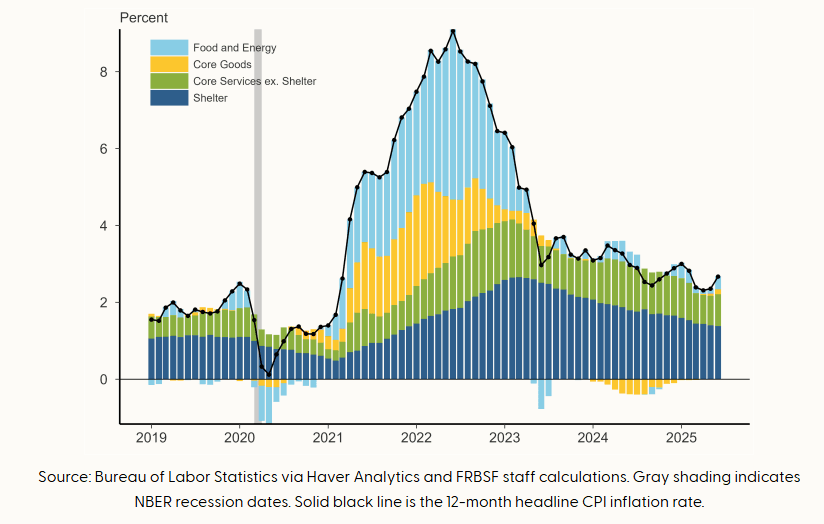
Towards the end of June, hard data came in from the US: retail sales, industrial production and housing. Most of the data came in weaker than expected with retail sales shrinking almost 1% on a month-to-month basis.
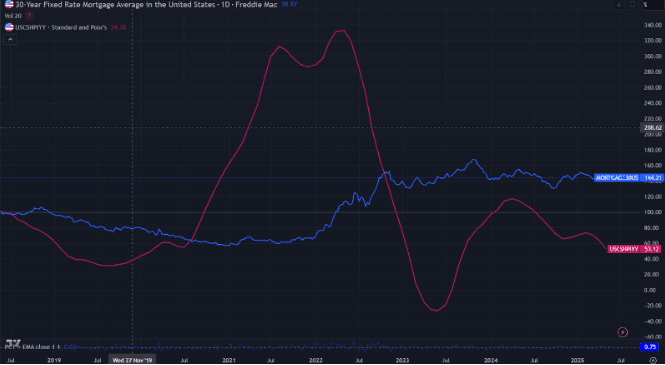
On housing, our core thesis remains: inelasticity of housing demand is reaching a real ceiling in the US, either mortgage rates or prices should correct. As said before, weaker housing will have a dampening effect on inflation and we remain in the medium-term disinflationary camp. Below we have in blue the 30yr mortgage rate that remains elevated and in red the Case-Shiller housing price index, which is back on a downward trend again.
One way NINA looks at all this data is from the perspective of flows. Flows from institutions and retail investors, and how that relates to passive investing. But we don't just look at the numbers themselves. We look at the mechanism between economic growth, the labor market and flows. As a brief sidestep, let me explain this below.
For example: a better labor market can translate to more excess savings and pension contributions that flow into ETFs. We continuously monitor that relationship. That is because these ETFs buy the mega cap companies at any price, with no valuation discrimination, leading to the price inelasticity of demand hypothesis made by Gabaix and Koijen in their paper of 2021.
What we posit in our system is that fundamentals based valuation metrics do not inform you enough on whether or not a company is overvalued. Neither do they tell the entire story on whether the direction of that valuation will be up or down in the medium term. For that NINA estimates a macro transmission mechanism for the companies.
As is widely known, looking at equity market returns, we can dissect it into the product of two components. Earnings growth and valuation growth (multiple expansion).
For example, looking at Walmart (~a month ago), over the past 10 years its earnings have grown about 66% whereas the price earnings multiple has grown over almost 180%. The product of those two numbers is the return we have seen over the past 10 years of holding stocks of that company.
Now this is just one company. You can aggregate these numbers up for each firm in the index to get to the market earnings growth and valuation growth. Depending on how you weigh each company, you can get various results. But staying with ETFs that track indices such as the MSCI world or the S&P 500, which weigh firms based on market capitalization you get a similar picture when aggregated. So It's that increase in the price investors are willing to pay for companies and not the growth of the company earnings themselves that has been the predominant factor of returns most recently.
We see that its macro driving the direction of the valuation growth. Not only through rates, but also through economic growth, pushing investors to front run earnings growth, both through passive investing and to some degree active as well. This combination of macro and fundamentals based analysis is extremely potent. NINA looks more at the fundamentals of a company for earnings growth and at the macro picture for valuation growth (multiple expansion).
Looking ahead:
Moving into July, things don’t all look good. Are we heading to the next equity market crash? Is the growth and inflationary hit from tariffs coming through?
The market celebrated the last US jobs report as a sign of strength, but we believe there’s more. Metrics like the ‘unemployment-to-opening’ ratio show labor market stabilization. However, momentum in this normalization can quickly turn into labor market weakness.
The One Big Beautiful Bill passed and we expect the policies to be net negative for growth and pose some risks to the labor market. For example the healthcare spending cuts put the private healthcare sector at risk, one of the sectors that contributes strongly to labor market growth.
The slew of data last week has been net positive, especially when looking at the economic fundamentals. Still NINA’s macro assessment on many, especially cyclical companies, remains at the crossroads between outright bearishness and worth to keep. The outlook for safe haven assets such as gold, on the other hand, is slowly becoming less positive following the data this week.
The data also provides information on the direction of Fed decision making. Markets now price in only one cut, instead of the previous two this year. Besides the expectations of central banks, we also monitor the fiscal outlook. Many markets now find themselves in a place where the fiscal picture matters just as much as the monetary one. This is especially true when looking at the US, with debt levels more than 100% of GDP, and tools like activist treasury issuance.
The latter is a term coined by Roubini and Miran (who is now part of the US administration), where the treasury issues less long end coupon bonds to suppress long rates whilst issuing more bills, in effect injecting liquidity into the system.
Looking at the data and just the outstanding debt, we now have bills around 20% of the marketable debt securities, which is still high and stimulative but seems to be normalizing. We need to continue to monitor the net issuance profile, which is what NINA does.
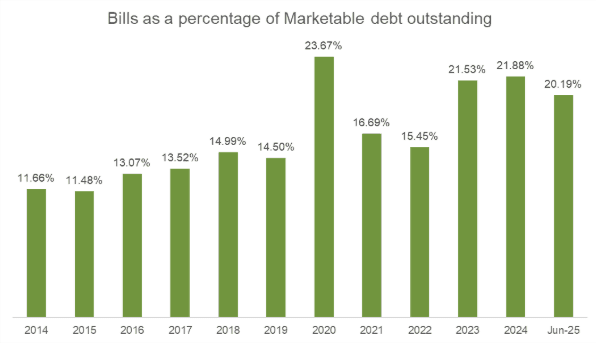
*Source: SIFMA
We say we invest in the economy of tomorrow, with the technology of tomorrow. That means for example investing in companies that are dominant in industries with a secular upward trend. But equally important is how the changes in the economy of tomorrow will affect those industries.
Interestingly we saw that the global economy was slowing down at the end of last year, but would have started accelerating from March this year, were it not for the negative impulses from the US. Mid April to June we were hungry for risk, whilst also positive on precious metals.
Now we have spreads and equity implied volatility measures at their lows, while fixed income vol measures remain elevated and financial conditions measures historically loose.
Until we find more justification for this in the data, specifically in growth signals that support expansionary industries, we remain underexposed in those positions, whilst maintaining concentration. We have 21 positions, with exposure to consumer, health, tech and precious metals. With a net exposure of ~60% in equities and total exposure of ~80%. I fully understand that there is still liquidity running through the system looking for a home. See for example ARK ETF, Robinhood, etc. But, I am okay with some of our high impact positions in AI and health, to return less this month, whilst managing macro risk so we can step on the gas as we get more clarity from the data. We are not looking to win every battle, but to be a victor in the long run.
Performance:
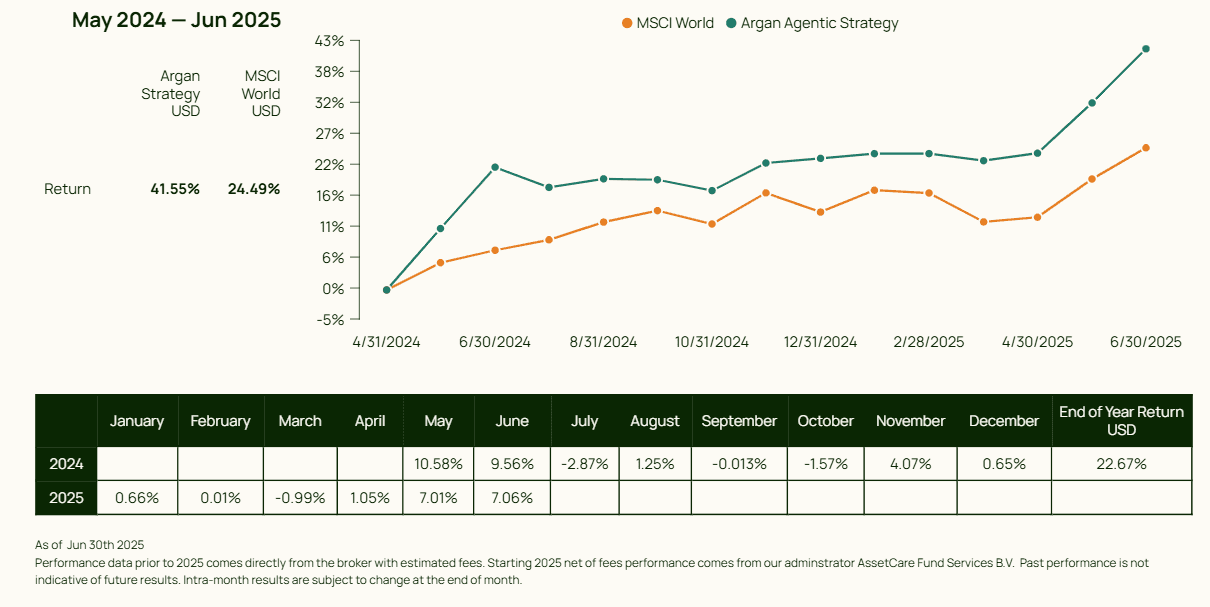
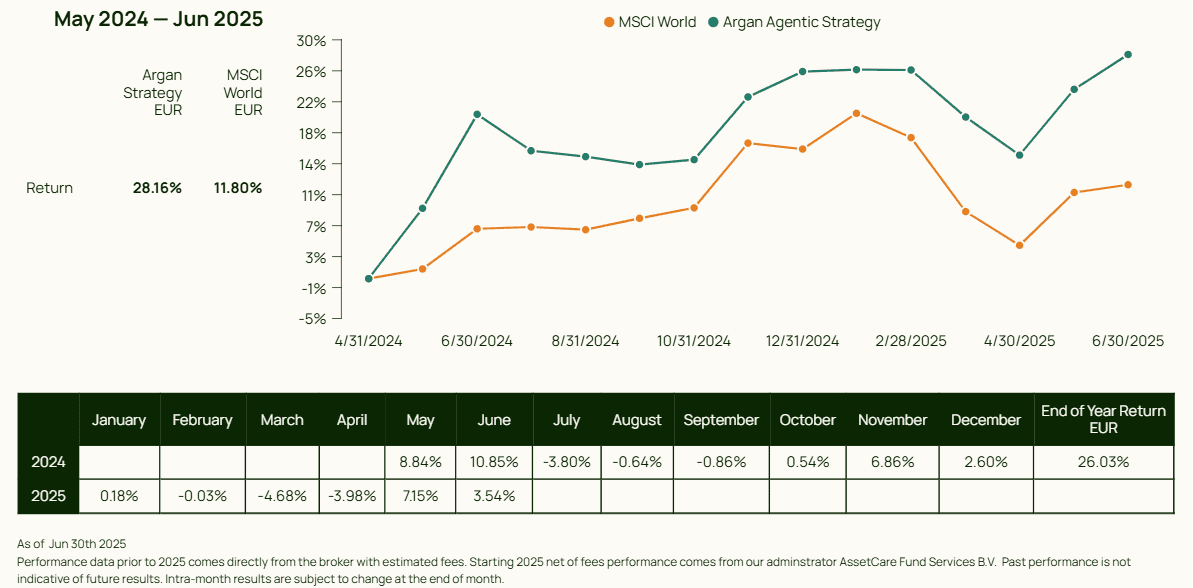
It was a fantastic month, delivering a 7.1% return (USD), 3.54% (EUR). That brings our returns since inception to 28.16% versus the 11.80% of the MSCI World and 41.55% versus 24.49% in USD. Again, without the dire drawdowns we saw in the turbulent months of 2024 and April this year.
We like to compare argan.ai to the best strategies globally and the largest funds in the world. It is really a David vs. Goliath situation. The Dutch contender taking on the big leagues, without their budgets and scale. Our expertise? As said before, we invest in the economy of tomorrow with the technology of tomorrow. Uniquely combining macro and micro, and quant and AI.
From here on all reported returns are net of fees.
Argan.ai:
The past month brought meaningful progress across key initiatives. We're excited to share some of our latest developments.
Our macro updates are getting traction on LinkedIn! In June we published multiple: week 27, week 26, week 25, week 24.
Make sure to follow us for, among others, our weekly macro update: Follow argan.ai on LinkedIn